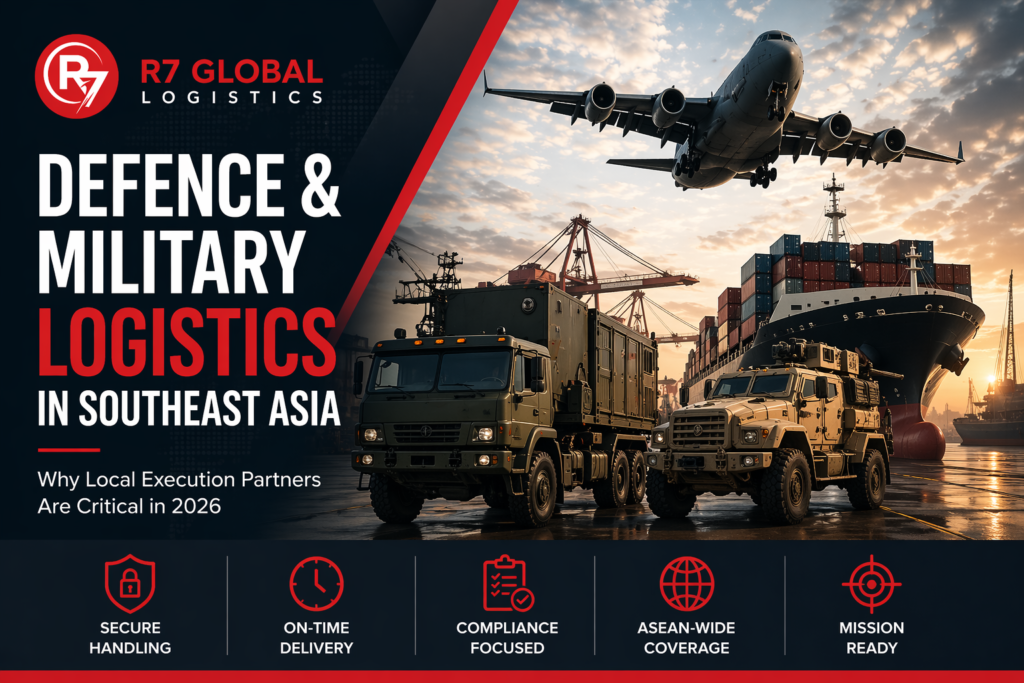
Defence & Military Logistics in Southeast Asia: Why Local Execution Partners Are Critical

Introduction

Defence logistics in Southeast Asia has become increasingly complex, requiring a combination of secure handling, regulatory compliance, and precise execution.

For defence suppliers, contractors, and government-linked entities operating across ASEAN, logistics is no longer just about transportation—it is about ensuring mission readiness, security, and operational reliability.

As demand for defence logistics in Southeast Asia continues to grow, the need for experienced, on-ground execution partners has become critical.

What Is Defence & Military Logistics?

Defence and military logistics refers to the planning, coordination, and movement of:

  • Sensitive equipment
  • Controlled cargo
  • Military-grade materials
  • Time-critical shipments

Unlike commercial logistics, defence logistics requires:

  • Strict compliance with international and local regulations
  • Secure handling and controlled access
  • Chain-of-custody tracking
  • Coordination with authorised facilities and personnel

Why Defence Logistics in Southeast Asia Is More Complex

1. Diverse Regulatory Environments

Each ASEAN country—including Malaysia, Singapore, Indonesia, Thailand, and Vietnam—has different:

  • Customs regulations
  • Import/export restrictions
  • Defence-related compliance requirements

This makes cross-border defence logistics significantly more complex than standard freight operations.

2. Cross-Border Coordination Across ASEAN

Defence cargo often moves across multiple countries in Southeast Asia.

This requires:

  • Accurate documentation at every stage
  • Strong relationships with customs and authorities
  • Seamless coordination across borders

Without proper execution, delays and compliance risks increase significantly.

3. Infrastructure and Operational Differences

From highly developed logistics hubs like Singapore to emerging markets in Vietnam and Indonesia, infrastructure varies across the region.

This requires:

  • Flexible logistics strategies
  • Local operational knowledge
  • Strong execution on the ground

The Importance of a Local Defence Logistics Partner

Global logistics providers may offer reach—but execution happens locally.

A trusted local partner provides:

✔ On-Ground Operational Control

Ensuring cargo is handled securely and efficiently at every stage.

✔ Compliance & Regulatory Expertise

Managing customs clearance, permits, tax structures, and local regulations.

✔ Secure Handling of Sensitive Cargo

Maintaining strict chain-of-custody and controlled access protocols.

✔ Support for Time-Critical Operations

Handling urgent shipments, AOG movements, and mission-sensitive timelines.

Core Defence Logistics Capabilities

To support defence and military operations, logistics providers must offer:

Secure Cargo Handling

  • Controlled handling of sensitive equipment
  • Chain-of-custody tracking
  • Coordination with authorised personnel

Freight & Transportation Solutions

  • Air, sea, and multimodal transport
  • Heavy and oversized cargo handling
  • Project cargo logistics

Customs, Tax & Compliance (ASEAN)

  • Import/export clearance for controlled goods
  • Advisory on duties, taxes, and exemptions
  • Temporary imports for exhibitions and trials

Last-Mile & On-Site Delivery

  • Delivery to ports, bases, and restricted sites
  • High-security coordination
  • Installation and site logistics support

Supporting Mission-Critical Logistics Operations

Defence logistics often involves urgent and high-risk scenarios.

Key support areas include:

  • AOG / urgent shipments with rapid mobilisation
  • Defence exhibitions & events logistics (e.g. DSA)
  • Overflow logistics support during supply chain constraints
  • Regional coordination across Southeast Asia

Why ASEAN Regional Coverage Matters

For defence contractors operating across multiple countries, a regional logistics strategy is essential.

Benefits include:

  • Centralised coordination
  • Consistent execution standards
  • Reduced operational risk
  • Improved efficiency across borders

Working with a single logistics partner across ASEAN simplifies complexity and improves reliability.

Why Companies Are Rethinking Defence Logistics

Organisations are shifting away from fragmented logistics networks.

Instead, they are prioritising:

  • Fewer, more capable logistics partners
  • Strong regional presence in Southeast Asia
  • Proven experience in complex logistics operations
  • Reliable, compliant execution

The focus is no longer just cost—it is:

execution certainty, compliance, and operational control


Defence Logistics Solutions by R7 Global Logistics

R7 Global Logistics provides specialised defence logistics services in Southeast Asia, supporting contractors, suppliers, and government-linked organisations.

Our capabilities include:

  • On-ground execution across Malaysia and ASEAN
  • Secure handling of sensitive and controlled cargo
  • Customs, tax, and regulatory coordination
  • Project-based and urgent logistics support
  • Cross-border logistics management across Southeast Asia

We act as a trusted local execution partner, ensuring reliable and compliant logistics operations.

Conclusion

Defence and military logistics in Southeast Asia requires more than just transportation—it demands precision, compliance, and reliable execution.

As supply chains become more complex, companies that invest in strong regional logistics partners will be better positioned to manage risk and deliver on mission-critical operations.

Let’s Support Your Next Deployment


Whether you’re managing sensitive cargo or coordinating regional operations, R7 Global Logistics provides secure and compliant execution across Southeast Asia.

contact us : defence@r7intl.com


Scroll to Top