
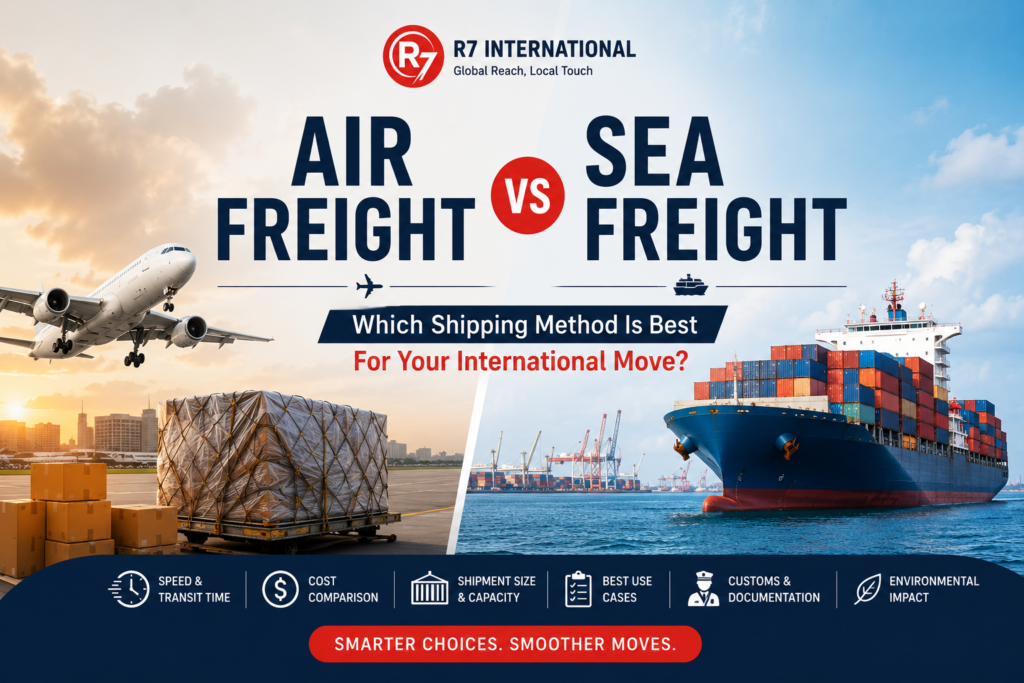
Air Freight vs Sea Freight: Which Shipping Method Is Best for International Moves?
When planning an international move, one of the most important decisions you’ll make is choosing how your household goods will be transported.
For most relocations, the choice comes down to air freight vs sea freight.
Both options have advantages and disadvantages, and the right solution depends on your timeline, budget, shipment size, and destination country. While some expatriates need their belongings delivered as quickly as possible, others prioritize cost savings and larger shipment capacity.
Understanding the differences between air freight and sea freight can help you make an informed decision and avoid unnecessary expenses or delays.
In this guide, we’ll compare both shipping methods and explain which option is best for different types of international relocations.
Air Freight vs Sea Freight: Quick Comparison
| Factor | Air Freight | Sea Freight |
|---|---|---|
| Transit Time | 3–10 Days | 4–8 Weeks |
| Cost | Higher | Lower |
| Shipment Size | Small to Medium | Medium to Large |
| Best For | Urgent Moves | Full Household Moves |
| Customs Clearance | Generally Faster | Standard Processing |
| Environmental Impact | Higher | Lower |
| Popular Use | Essential Items | Furniture & Household Goods |
For most international relocations, the choice between air freight and sea freight comes down to speed versus cost.
What Is Air Freight?
Air freight involves transporting household goods via commercial or cargo aircraft.
It is the fastest method of international shipping and is commonly used when employees need essential belongings quickly after arriving in their destination country.
Advantages of Air Freight
Faster Delivery
One of the biggest advantages of air freight is speed.
Most shipments arrive within:
- 3 to 10 days
- Depending on destination
- Subject to customs clearance
This makes air freight ideal for urgent relocations.
Better for Essential Items
Many relocating employees use air freight to transport:
- Clothing
- Personal documents
- Children’s essentials
- Laptops and electronics
- Daily necessities
This allows them to settle into their new home while waiting for larger shipments to arrive by sea.
Reduced Storage Requirements
Because delivery is significantly faster, there is often less need for temporary purchases or storage arrangements.
Disadvantages of Air Freight
Higher Costs
Air freight is significantly more expensive than sea freight.
Pricing is based on:
- Weight
- Volume
- Destination
- Airline capacity
For larger household shipments, costs can increase quickly.
Limited Capacity
Air freight is not designed for transporting:
- Large furniture
- Full household contents
- Vehicles
- Bulky items
As shipment size increases, sea freight usually becomes more economical.
What Is Sea Freight?
Sea freight involves transporting household goods in shipping containers.
It remains the most common shipping method for international household relocations because it offers the best balance between cost and capacity.
Advantages of Sea Freight
Cost-Effective for Larger Shipments
Sea freight is generally the most economical option for:
- Family relocations
- Long-term assignments
- Full household moves
The larger the shipment, the greater the savings compared to air freight.
Greater Capacity
Sea freight can accommodate:
- Furniture
- Appliances
- Household goods
- Personal effects
- Office equipment
This makes it ideal for comprehensive relocations.
Lower Environmental Impact
Compared to air freight, sea freight typically produces a lower carbon footprint per shipment.
Many organizations with sustainability goals prefer sea freight whenever timelines allow.
Disadvantages of Sea Freight
Longer Transit Times
Sea freight typically requires:
- 4 to 8 weeks
- Depending on shipping routes
- Port schedules
- Customs clearance procedures
Planning ahead is essential.
Potential Port Delays
Shipping schedules can occasionally be affected by:
- Port congestion
- Weather conditions
- Customs inspections
- Vessel scheduling changes
While these delays are usually manageable, they should be considered during move planning.
Understanding FCL and LCL Shipping
When using sea freight, shipments are typically transported using one of two methods.
Full Container Load (FCL)
FCL means you have exclusive use of a shipping container.
Benefits include:
- Reduced handling
- Faster loading and unloading
- Greater shipment security
- Ideal for larger households
Less than Container Load (LCL)
LCL combines multiple shipments within the same container.
Benefits include:
- Lower costs
- Suitable for smaller shipments
- Flexible shipping options
LCL is commonly used for smaller international moves where a full container is not required.
When Should You Choose Air Freight?
Air freight may be the better option if:
✓ You need your belongings urgently
✓ You are relocating on short notice
✓ You only require essential items
✓ Your employer covers relocation expenses
✓ You are shipping a relatively small volume
Common examples include:
- Executive relocations
- Temporary assignments
- Emergency deployments
- Initial relocation shipments
When Should You Choose Sea Freight?
Sea freight is often the preferred option when:
✓ You are moving a complete household
✓ Budget is an important factor
✓ You can plan several weeks ahead
✓ Furniture and larger items are included
✓ Long-term relocation is planned
This remains the most popular choice for international family relocations.
Air Freight vs Sea Freight in Southeast Asia
For relocations across Malaysia, Singapore, Thailand, Vietnam, and Indonesia, shipping decisions often depend on destination requirements and customs procedures.
Malaysia
Both air freight and sea freight are commonly used depending on shipment size and assignment timelines.
Singapore
Air freight is frequently selected for corporate relocations due to tight project schedules and shorter assignment lead times.
Thailand
Sea freight remains popular for family relocations and larger household shipments.
Vietnam
Many expatriates use a combination of air and sea freight to balance cost and convenience.
Indonesia
Sea freight is often preferred for larger household moves due to shipment volume and transportation economics.
Can You Use Both Air and Sea Freight?
Absolutely.
Many international relocations use a combination of both methods.
A typical approach is:
Air Freight
For:
- Essential clothing
- Personal items
- Children’s necessities
- Work equipment
Sea Freight
For:
- Furniture
- Appliances
- Household goods
- Non-urgent belongings
This hybrid approach provides flexibility while controlling overall relocation costs.
Frequently Asked Questions
Is air freight more expensive than sea freight?
Yes. Air freight typically costs significantly more but offers much faster delivery times.
How long does sea freight take for an international move?
Most sea freight household goods shipments take between four and eight weeks depending on route and customs clearance requirements.
Can I ship furniture by air freight?
Technically yes, but the cost is often prohibitively expensive for larger furniture items.
Is sea freight safer than air freight?
Both methods are generally safe when handled by professional relocation providers. Proper packing and documentation are the most important factors.
Can I combine air and sea freight?
Yes. Many international relocations use a hybrid approach where essential items travel by air and larger household goods travel by sea.
International Shipping Checklist
Before selecting your shipping method, consider:
✓ Relocation timeline
✓ Budget requirements
✓ Shipment size
✓ Destination customs requirements
✓ Temporary accommodation arrangements
✓ Delivery access at destination
✓ Insurance coverage
✓ Employer relocation policies
Final Thoughts
There is no single answer to the air freight vs sea freight question.
The best option depends on your relocation timeline, budget, shipment volume, and destination requirements. While air freight offers unmatched speed, sea freight remains the preferred solution for most international household relocations due to its cost-effectiveness and ability to handle larger volumes.
Many clients ultimately benefit from a combination of both methods, allowing essential belongings to arrive quickly while larger household goods follow by sea.
At R7 International, we help individuals, families, and businesses determine the most suitable shipping solution for international moves across Malaysia, Singapore, Thailand, Vietnam, Indonesia, and beyond.
For assistance with international moving, freight planning, and customs clearance, contact us at info@r7intl.com.