
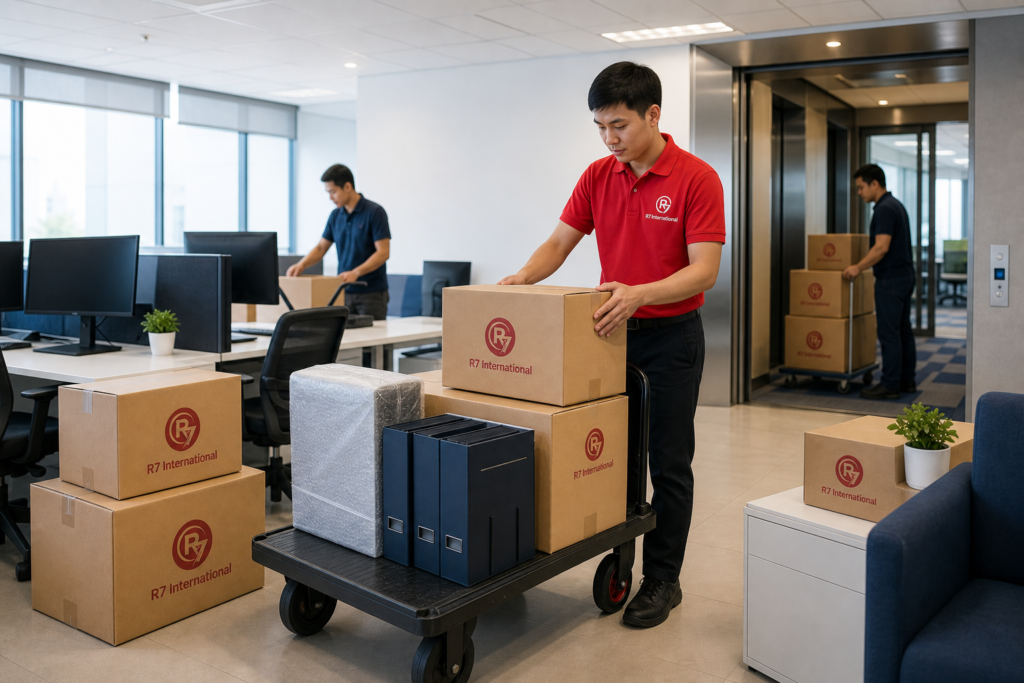
Moving an office between Malaysia and Singapore is not simply a matter of loading desks onto a truck and crossing the border. The physical distance may be manageable, but the move still involves two locations, two sets of building rules and a business that needs to keep operating.
A successful cross-border office relocation starts with a clear plan for people, equipment, documents, access and timing. It also recognises that every business has different priorities: one company may be moving a small project team, while another needs to transfer an entire workplace with servers, archive files and specialist equipment.
This guide outlines the practical issues businesses should consider when planning an office move between Malaysia and Singapore.
Start with the business objective
Before discussing cartons and vehicles, define what the relocation needs to achieve. Is the business consolidating offices, opening a new branch, moving closer to customers or transferring a team to support regional growth?
The objective affects the schedule, the items being moved and the level of service required. A short-term project move may need a phased transfer, while a permanent relocation may include furniture, IT equipment, archives, meeting-room contents and employee workstations.
Agree on the non-negotiable requirements early. These may include a fixed operational deadline, no disruption to customer service, secure handling of confidential records or the ability to test IT systems before staff arrive.
Survey both offices
A survey of the origin and destination offices gives the moving team a practical view of the work involved. It should cover loading areas, parking, lifts, stairways, corridors, security desks, building booking systems and the route to each workstation or storage area.
Do not assume that access will be the same at both ends. A modern office tower may require a lift reservation and delivery window, while a ground-floor unit may have a narrow loading bay or restricted vehicle access.
Ask each building manager for the current moving procedures, insurance requirements, access forms and approved working hours. Share this information with the relocation team before the move date is confirmed.
Create a complete asset register
An office relocation is easier to control when every asset has a clear destination. Build a register covering furniture, monitors, computers, network equipment, printers, records, kitchen items and specialist equipment.
For higher-value or sensitive assets, record the make, model, serial number and condition where appropriate. Use photos for items that may need to be reassembled or checked after delivery.
Separate items into clear groups:
- move to the new office;
- store temporarily;
- recycle, donate or dispose of securely;
- replace at destination; and
- remain at the current location.
This exercise often identifies equipment that no longer needs to travel. Removing surplus items can reduce handling, transport volume and the time needed to set up the new workplace.
Plan customs and cross-border documentation early
Assets moving between Malaysia and Singapore may need accurate shipment information and supporting documentation. Requirements can depend on the type of goods, ownership, value, route and the circumstances of the move.
Prepare clear descriptions rather than broad labels such as “office items”. A list that distinguishes monitors, laptops, desks, chairs, server equipment and archive cartons is easier to review than a general description.
Unusual, controlled or high-value equipment should be raised early with the appropriate customs adviser or relocation partner. Do not wait until the vehicle is ready to cross the border to discover that an item needs additional information.
For an example of the practical considerations involved in the route, see our guide to moving from Singapore to Malaysia.
Protect data and IT equipment
IT equipment needs a separate workstream within the office move. Confirm who is responsible for shutdown, backup, disconnection, packing, transport, reconnection and testing.
Servers, storage devices, networking equipment and specialist systems may need controlled handling and a planned chain of custody. Confidential information should be protected throughout the move, including when equipment is temporarily stored.
Our guide to moving IT equipment and servers during an office relocation covers some of the questions that should be addressed before the moving team arrives.
Allow time for testing at the destination. A workstation that has been delivered is not necessarily a workstation that is ready for use.
Choose a phased or single move
There is no single correct way to move an office. A single move may suit a small operation that can close for a short period. A phased move may be better for a larger business that needs to keep key functions working throughout the transition.
A phased plan could move non-critical furniture and archive material first, followed by workstations, meeting-room equipment and IT systems. The sequence should reflect business priorities rather than simply following the order in which items are packed.
For each phase, identify the people responsible, the items included, the access window, the expected completion time and the fallback plan if a delivery is delayed.
Coordinate employees and stakeholders
Employees need practical information well before moving day. Tell them what is happening, when they should clear their desks, which items they may take home and when the new office will be ready.
Clients, suppliers, building management and service providers may also need notice. Update delivery addresses, visitor instructions, signage, emergency contacts and any records that depend on the office location.
A short move handbook or shared checklist can prevent repeated questions. Include the old and new addresses, key dates, parking and access instructions, IT downtime windows and the contact for urgent issues.
Prepare the new office before delivery
Delivery is smoother when the destination is ready to receive the shipment. Confirm that utilities, access cards, internet services, furniture layouts and workstation locations are in place or have a clear owner.
Mark rooms, departments or workstation zones so cartons and furniture can be placed correctly. If the new office is still being fitted out, agree on where items will be staged and who will protect them from dust, construction work or accidental damage.
Keep a list of priority items that need to be installed first. This may include reception equipment, network hardware, meeting-room technology or essential workstations.
Build in contingency time
Cross-border moves are affected by more than the packing schedule. Border processing, building access, traffic, weather, documentation questions and equipment testing can all change the timing.
Build reasonable contingency into the plan and avoid setting the first working day immediately after delivery without a recovery window. If the business must open on a fixed date, consider moving critical equipment earlier or arranging temporary workarounds.
Keep stakeholders updated when the plan changes. Early communication is usually easier for employees and customers to manage than a last-minute surprise.
How R7 can help
R7 can help coordinate the practical parts of a Malaysia–Singapore office relocation, from survey and asset planning to packing, transport, storage and delivery. The right approach depends on the size of the office, the equipment involved and how much operational downtime the business can accept.
Our relocation services provide a starting point for understanding how workplace and relocation requirements can be brought together. If you are planning a cross-border office move, contact R7 International to discuss the project.
Cross-border office relocation checklist
- Business objective and operational deadline agreed
- Origin and destination offices surveyed
- Building access and booking requirements confirmed
- Asset register and destination plan prepared
- Customs and shipment documentation reviewed
- IT shutdown, transport, reconnection and testing assigned
- Employees and key stakeholders briefed
- Phased move or single-move plan approved
- Contingency time and fallback arrangements included
A Malaysia–Singapore office relocation is easier to manage when the border crossing is treated as one part of a wider business continuity plan. With the right information gathered early, the moving team can focus on protecting the assets and helping the business get back to work.