
Introduction
Two months on from our last update, the situation in the Middle East has not stabilized.
If anything, the impact on global shipping has become more severe.
Freight rates remain elevated. Transit times are longer. Capacity is tighter.
For anyone planning an international move or shipment, this is no longer a temporary disruption—it is the current reality.
What Has Changed Since March
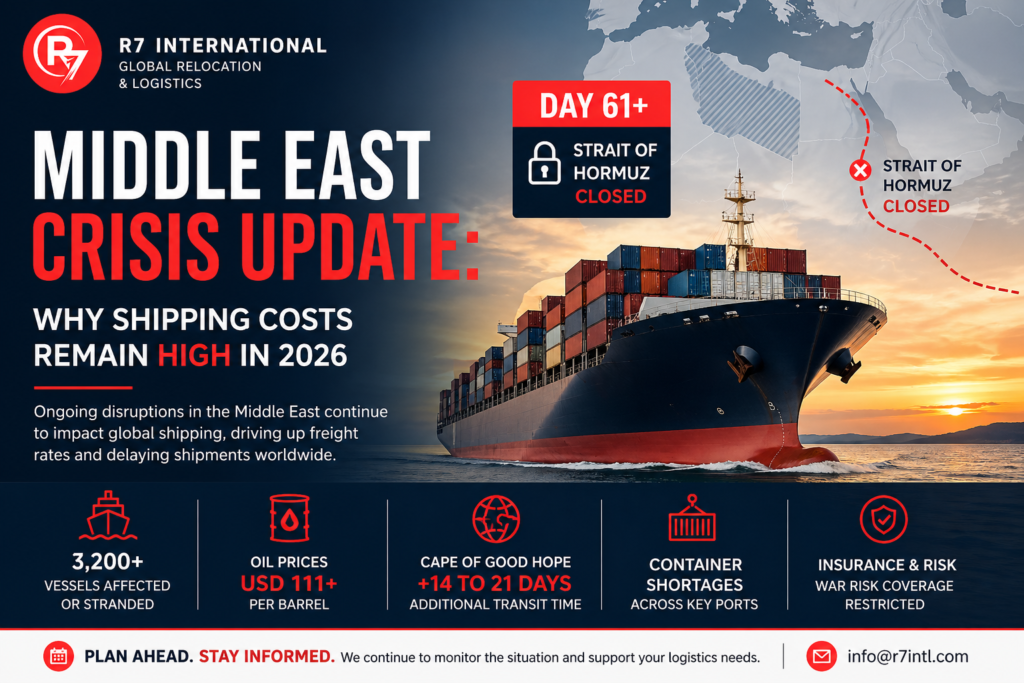
The Strait of Hormuz remains closed, now extending beyond 60 days.
This has effectively removed one of the most critical shipping lanes in the world.
At the same time:
- Over 3,000 vessels are affected or rerouted
- Oil prices have surged past USD 111 per barrel
- No clear resolution is in sight
The result is a sustained disruption across global supply chains.
The New Shipping Reality
Shipping lines have adapted—but not without consequence.
With traditional routes unavailable, vessels are now consistently rerouted via the Cape of Good Hope.
This means:
- An additional 2–3 weeks in transit
- Increased fuel costs
- Reduced global vessel availability
This is no longer a contingency plan. It is now standard routing.
Why Costs Are Still High
Freight rates are not increasing randomly—they are being driven by multiple compounding factors:
- Longer routes = higher operating costs
- Fuel prices rising significantly
- Equipment shortages across key hubs
- Port congestion due to rerouted cargo
On top of that, carriers continue to introduce surcharges to manage risk and capacity.
The result is a market where pricing remains volatile and consistently elevated.
Capacity Is the Bigger Problem
While cost is the most visible issue, capacity is often the bigger challenge.
Across the region:
- Container availability is limited
- Booking space is tighter
- Ports are handling displaced cargo volumes
Even where ports remain operational, delays and backlogs are now common.
Air Freight Is Not a Simple Alternative
Many assume air freight can solve these delays—but capacity constraints exist there as well.
Reduced flight availability and operational restrictions mean:
- Limited space
- Higher pricing
- Strict booking timelines
This makes planning even more critical.
Insurance and Risk Factors
Another major shift is in cargo insurance.
War risk coverage has been withdrawn or restricted in certain areas, requiring more careful coordination before shipments can proceed.
This adds an additional layer of complexity for both businesses and individuals.
What This Means for You
If you are planning a move or shipment right now, there are a few key takeaways:
- Expect longer transit times
- Budget for higher costs
- Plan earlier than usual
Most importantly, work with a partner who understands the current landscape and can guide you through it.
If you are evaluating options, you can also refer to our guide on how to choose an international moving company to ensure you select the right partner.
Looking Ahead
There is currently no clear timeline for when conditions will return to normal.
With ongoing geopolitical uncertainty and no confirmed resolution, the industry is operating under the assumption that disruptions will continue in the near term.
Planning based on pre-2026 timelines or pricing is no longer realistic.
Conclusion
The global logistics environment in 2026 is being shaped by sustained disruption, not short-term volatility.
Understanding this allows you to plan more effectively, avoid surprises, and make better decisions for your move or shipment.
Contact Us
If you need guidance based on current shipping conditions, our team is here to help.
Contact us at info@r7intl.com to discuss your requirements.