
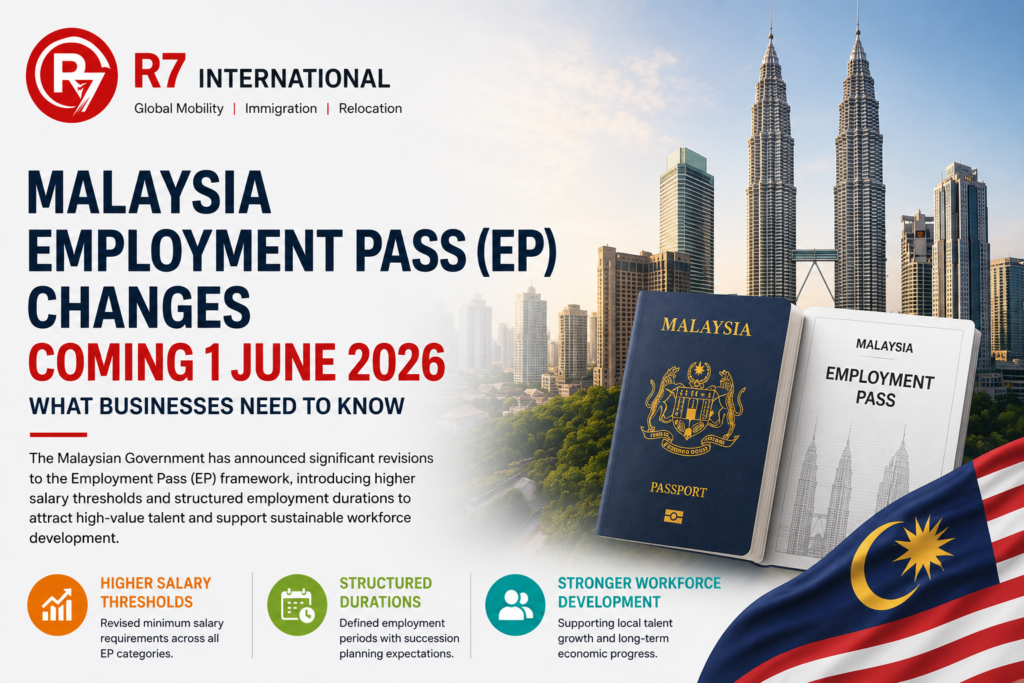
Malaysia Employment Pass Changes 2026: What Employers Need To Know
Malaysia has announced major updates to its Employment Pass (EP) framework, with new salary thresholds and employment duration requirements scheduled to take effect from 1 June 2026.
The changes represent one of the most significant revisions to Malaysia’s expatriate employment policies in recent years and will directly impact multinational companies, HR teams, global mobility professionals, and foreign talent currently working or planning to work in Malaysia.
For employers managing international assignments and expatriate workforce planning, early preparation will be essential to ensure compliance and avoid disruptions to business operations.
Key Changes To Malaysia’s Employment Pass Framework
According to announcements issued through Malaysia’s immigration and expatriate management authorities, Employment Pass applications submitted from 1 June 2026 onwards will be subject to revised salary requirements and updated employment duration criteria.
The revised framework aims to strengthen Malaysia’s position as a destination for highly skilled foreign talent while supporting long-term workforce development and knowledge transfer initiatives.
Revised Employment Pass Salary Thresholds
The announced changes include substantial increases to the minimum salary requirements across all Employment Pass categories.
| Employment Pass Category | Current Minimum Salary | Announced Revised Salary |
|---|---|---|
| Category I | RM10,000+ | RM20,000+ |
| Category II | RM5,000 – RM9,999 | RM10,000 – RM19,999 |
| Category III | RM3,000 – RM4,999 | RM5,000 – RM9,999* |
*Certain manufacturing-related services may be subject to specific Category III salary ranges.
These revised thresholds are expected to apply to both new applications and renewal submissions lodged after the implementation date.
New Employment Duration Structure
Alongside salary revisions, Malaysia is also introducing clearer employment duration guidelines for expatriate employees.
Category I
- Employment duration of up to 10 years
Category II
- Employment duration of up to 10 years
- Subject to succession planning requirements
Category III
- Employment duration of up to 5 years
- Subject to succession planning requirements
The introduction of structured employment periods reflects Malaysia’s broader emphasis on long-term workforce planning and local talent development.
What This Means For Employers
The upcoming changes are likely to affect several areas of workforce and mobility management.
1. Expatriate Compensation Planning
Organizations should review existing expatriate salary structures to determine whether current remuneration packages meet the announced requirements for future renewals and new hires.
2. Renewal Preparation
Companies with Employment Pass holders due for renewal after June 2026 should begin planning well in advance to identify any potential salary gaps or compliance concerns.
3. Workforce Succession Strategies
For positions that may fall under Category II and Category III requirements, employers should consider documenting local talent development and succession planning initiatives where applicable.
4. Budget Forecasting
The higher salary thresholds may increase overall expatriate employment costs, making it important for HR and finance teams to reassess future mobility budgets.
5. Immigration Compliance
As implementation details continue to evolve, employers should maintain close communication with experienced immigration and mobility specialists to ensure smooth application processing and compliance.
A Regional Trend Towards Strategic Talent Mobility
Malaysia’s Employment Pass revisions reflect a broader trend across Asia-Pacific markets.
Governments throughout the region are increasingly aligning immigration policies with economic development goals, placing greater emphasis on:
- Highly skilled foreign talent
- Competitive salary benchmarks
- Knowledge transfer initiatives
- Workforce localization strategies
- Sustainable talent development
For multinational organizations, this means that global mobility planning must become increasingly proactive rather than reactive.
How Employers Can Prepare Now
To minimize future disruption, organizations should begin reviewing:
- Current expatriate employee populations
- Upcoming Employment Pass renewals
- Compensation structures
- Talent mobility budgets
- Succession planning frameworks
- Immigration compliance processes
Early preparation will provide greater flexibility when the revised requirements take effect.
Final Thoughts
Malaysia’s announced Employment Pass reforms represent a significant evolution in the country’s approach to expatriate employment and talent mobility.
While the changes may require employers to reassess compensation and workforce planning strategies, they also provide greater clarity around long-term expatriate employment and talent development expectations.
Organizations that begin preparing now will be best positioned to maintain compliance, retain critical international talent, and ensure uninterrupted business operations when the new framework comes into effect.
Need Support With Employment Pass Applications?
R7 International provides immigration support, global mobility coordination, destination services, and expatriate relocation solutions across Malaysia and ASEAN.
Whether you are planning a new expatriate assignment or preparing for upcoming Employment Pass renewals, our team can help you navigate evolving immigration requirements with confidence.
Contact us at info@r7intl.com or visit www.r7intl.com to learn more.
Relocating an employee and their family from Singapore? See our guide to moving from Singapore to Malaysia.